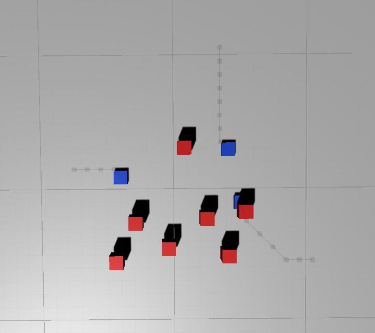
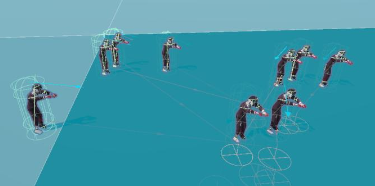
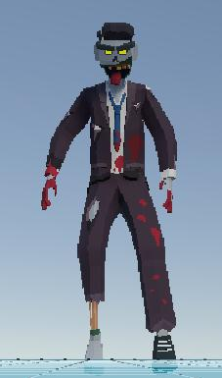
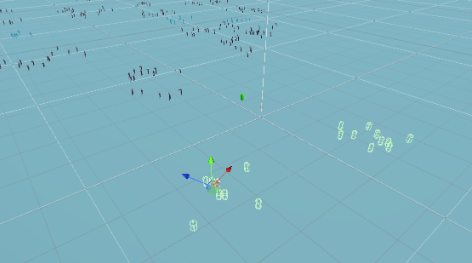
Final demonstrations of the custom A* and Unity NavMesh implementations.
Custom A* Navigation
Final demonstration of the custom A* AI navigation system.
Unity NavMesh
Final demonstration of the Unity NavMesh AI navigation system.
NavMesh vs Custom A*
How much control do you gain by building an AI navigation system yourself?
This project explores that question by comparing Unity's NavMesh-based
AI navigation with a custom-built A* alternative. Both systems were
designed to support a minimum of 1,000 AI-controlled enemies at a
stable 60 FPS.
1,000+
AI Agents Tested
60 FPS
Target Performance
2
Navigation Systems
Project Overview
Both implementations share the same underlying enemy state machine,
movement, player controller and Level of Detail (LOD) systems. The
key difference was the navigation layer: one relied on Unity's
NavMesh system, while the other used a custom A* implementation.
The project also explored optimisation techniques for large numbers
of AI agents, including squad-based navigation, AI-aware LOD and
frustrum culling.
Key Takeaway
NavMesh proved to be the more practical solution for large-scale AI,
while building A* demonstrated the trade-off between engine-provided
performance and the flexibility of a custom system.
A* Implementation
Grid Generation
The custom navigation system generates a 2D grid across the
level and uses physics checks and layer masks to determine
which nodes are walkable. The grid supports eight-directional
movement while preventing diagonal movement through obstacles.
Pathfinding
A* evaluates potential routes using movement cost and a
distance-based heuristic before reconstructing the resulting
path into world-space waypoints.
Path Request Architecture
To support large numbers of agents, I implemented a queued
path-request system, allowing AI agents to submit navigation
requests without directly managing the pathfinding process.
This separated grid generation, pathfinding and request
management into independent systems, making the navigation
architecture easier to manage and optimise.
Scaling to 1,000+ AI Agents
Supporting large numbers of agents required optimisation beyond
the navigation algorithms themselves.
Optimisation 01
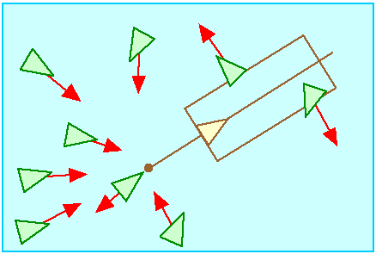
Squad-based Navigation
Enemies were organised into squads, with the leader
responsible for navigation requests while other members
followed the leader's movement. This reduced the number of
independent pathfinding and navigation checks required across
the AI population.
Optimisation 02
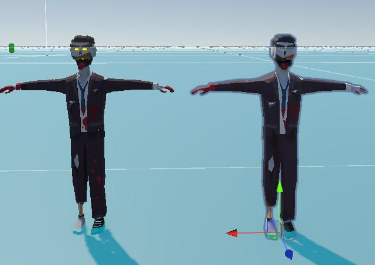
AI-aware LOD
Enemy simulation was scaled based on distance from the player.
Nearby enemies retained full AI and visual fidelity, while
distant enemies transitioned through lower-cost representations.
At sufficient distances, AI behaviours were suspended entirely,
putting agents into a sleep state while maintaining a visually
convincing scene.
Optimisation 03
Frustrum Culling
Enemy models outside the camera's view were disabled while
their underlying AI logic continued to run. When they
re-entered the camera's view, their visual representation
was restored and the appropriate LOD was selected.
Together, these techniques reduced the cost of both AI simulation and rendering,
allowing significantly larger numbers of enemies to be
presented without requiring every agent to operate at full fidelity.
Outcomes & Performance
The same optimisation techniques were applied to both systems
to provide a consistent comparison.
Custom A*
Navigation
1,000
AI Agents
60 FPS
After Optimisation
Before optimisation: 1,000 enemies at approximately 30 FPS.
After optimisation: 1,000 enemies at 60 FPS, with performance falling
below the target when increasing the population further.
Unity NavMesh
Navigation
3,000
Agents @ 60 FPS
5,000
Agents @ 30 FPS
Before optimisation: 1,000 enemies at just under 200 FPS.
After optimisation: Over 200 FPS at 1,000 enemies.
Further stress testing supported 3,000 enemies at
60 FPS and 5,000 enemies at 30 FPS.
Performance Summary
Unity's NavMesh demonstrated substantially greater scalability
in this implementation, supporting 3× as many agents at 60 FPS compared with the custom A* system.
Conclusion
The project demonstrated that both Unity's NavMesh and a custom
A* implementation can provide a scalable foundation for large-scale
AI systems. While the custom A* approach offered significantly
greater control and customisation over navigation behaviour, it
required substantially more development effort and, in this
implementation, performed less efficiently than Unity's NavMesh.
For this particular use case, NavMesh was the stronger solution,
providing significantly greater scalability with less development
overhead. The A* implementation nevertheless provided valuable
experience in designing navigation systems from the ground up and
could be better suited to future projects requiring specialised
navigation behaviour or greater control than an engine-provided
solution allows.
Future Applications
Open-world
Strategy
Simulation
Survival
In the future, this system could be expanded for use in
large-scale open-world, strategy, simulation or survival games,
where large numbers of AI agents need to navigate across complex
environments. Further development could explore dynamic navigation,
improved squad formations and more advanced AI behaviours.
Development & Technical Demos
Development footage demonstrating the implementation and progression
of the AI navigation and optimisation systems.